Why Standing Desks Can Cause Lower Back Pain and How Your Hip Flexors Are Involved
Disclosure / Affiliate Notice:
As an Amazon Associate I earn from qualifying purchases. Some links in this article may be affiliate links that earn me a commission at no extra cost to you.
The standing desk revolution has created an unexpected casualty: thousands of well-intentioned office workers now dealing with nagging lower back pain they never had while sitting. After observing this phenomenon for years and experiencing it myself, I’ve become convinced that the problem isn’t standing desks themselves—it’s our fundamental misunderstanding of what happens when we ask a body shaped by decades of sitting to suddenly stand upright for hours.
Here’s what most people don’t realize: your body is essentially a collection of muscles with very long memories. Those hip flexors at the front of your hips have spent years learning to be short and tight from constant sitting. When you suddenly ask them to support you in an upright position, they respond the only way they know how—by pulling your pelvis forward and forcing your lower back into an exaggerated arch.
The Real Culprit Behind Standing Desk Pain
In my experience working with people transitioning to standing desks, the pain pattern is remarkably consistent. It starts as a subtle tension, builds throughout the day, and eventually becomes that persistent ache that makes you question whether standing desks are worth the trouble. This isn’t random—it’s your hip flexors literally pulling your spine out of alignment.
What fascinates me about this mechanism is how predictable it is. Those tight hip flexors create what biomechanics experts call anterior pelvic tilt, which sounds technical but essentially means your pelvis tips forward like a bowl spilling water. Your lower back compensates by arching more than it should, concentrating pressure on joints that weren’t designed to handle that kind of sustained stress.
The cruel irony is that people often feel fine initially. The first hour or two of standing feels liberating after years of sitting. But as those hip flexors gradually tighten throughout the day, they progressively pull your posture further out of whack. By afternoon, you’re dealing with that deep, persistent tension that no amount of shifting your weight seems to relieve.
Why Your Glutes Have Abandoned You
Here’s something most standing desk advice completely ignores: your glute muscles have essentially gone on strike after years of sitting. I call this the great glute abandonment, and it’s a bigger problem than tight hip flexors alone. When these powerful muscles fail to activate properly during standing, your hip flexors and lower back muscles must pick up the slack.
This creates a vicious cycle that I’ve watched play out countless times. Weak glutes force other muscles to overwork, leading to increased tension and imbalance. Meanwhile, people unconsciously shift their weight to one leg while concentrating on work tasks, creating asymmetrical loading that compounds the problem. Your body tries to maintain balance through compensatory movements that inevitably involve your already-stressed lower back.
What most people overlook is that this isn’t just about muscle strength—it’s about muscle memory. Your nervous system has learned specific patterns over years of sitting, and it doesn’t abandon those patterns just because you’re now standing. Your brain continues activating muscles in familiar ways, often recreating aspects of sitting posture while upright.

The Footwear Factor Nobody Talks About
I’ve noticed that people rarely consider how their shoes interact with their standing desk setup, which is a mistake. High heels or shoes with elevated heels effectively shorten your hip flexors even further by changing your foot position. This amplifies the anterior pelvic tilt and increases that problematic lower back arch.
Standing on hard surfaces without adequate cushioning adds another layer of complexity. Your body works overtime to maintain balance and absorb constant pressure, creating tension that travels upward through your legs and hips directly into your lower back. It’s like asking an already-compromised system to handle additional stress.
The Ergonomic Mistakes That Make Everything Worse
Most standing desk setups I’ve observed make critical ergonomic errors that exacerbate hip flexor-related problems. When monitors are positioned too low, users bend forward at the hips, which actually stretches hip flexors while rounding the upper back. This creates a different but equally problematic postural pattern.
Conversely, monitors placed too high cause people to extend their necks and arch their backs even more, amplifying the excessive lumbar curve already created by tight hip flexors. These seemingly minor adjustments can dramatically accelerate the development of lower back pain in standing desk users.
A Personal Observation
In my experience, the people who struggle most with standing desk transitions are those who’ve been sedentary longest and expect immediate results. The body doesn’t work that way.
Who Should Pay Attention to This
This information is crucial for anyone considering a standing desk transition, especially if you’ve been sitting for most of your working life. It’s particularly relevant for people who’ve already tried standing desks and experienced lower back discomfort—you’re not imagining things, and you don’t need to abandon the concept entirely.
Office workers who spend eight or more hours daily in seated positions need to understand this connection before making the switch. The same applies to anyone who’s noticed their posture deteriorating over years of desk work or who’s dealing with general lower back stiffness even while sitting.

Who Can Probably Skip This
If you’re already physically active with good core strength and flexible hip flexors, you might transition to standing work more easily. People who regularly stretch, do yoga, or maintain consistent exercise routines often have better muscle balance to begin with.
Similarly, if you’re young and haven’t spent years in sedentary positions, your hip flexors likely haven’t developed the chronic tightness that creates standing desk problems. Your body may adapt more readily to position changes.
The Path Forward
Understanding this hip flexor connection changes everything about how you should approach standing desk use. Instead of viewing lower back pain as an inevitable consequence of standing, you can address the underlying muscle imbalances that create the problem.
The solution isn’t abandoning standing desks—it’s preparing your body for the transition through targeted hip flexor stretching, glute activation exercises, and gradual position changes. This process takes time, typically several weeks to months, but it’s far more sustainable than ignoring the root cause.
In my view, the standing desk movement has done people a disservice by oversimplifying the transition. Simply swapping sitting for standing without addressing years of postural adaptation is like expecting a marathon runner to excel at swimming without any technique training. The intent is good, but the execution needs work.
The key insight is that your body is remarkably adaptable, but it needs time and proper preparation to make significant changes. Those hip flexors can lengthen, those glutes can reactivate, and that lower back pain can resolve—but only if you understand what you’re working with and approach the transition systematically rather than expecting immediate results.
Addressing hip flexor tightness requires consistent stretching and muscle release work as part of any standing desk transition. Tools designed for muscle tension relief can help restore proper hip flexibility and reduce lower back stress. A practical example can be found here:
As an Amazon Associate I earn from qualifying purchases.
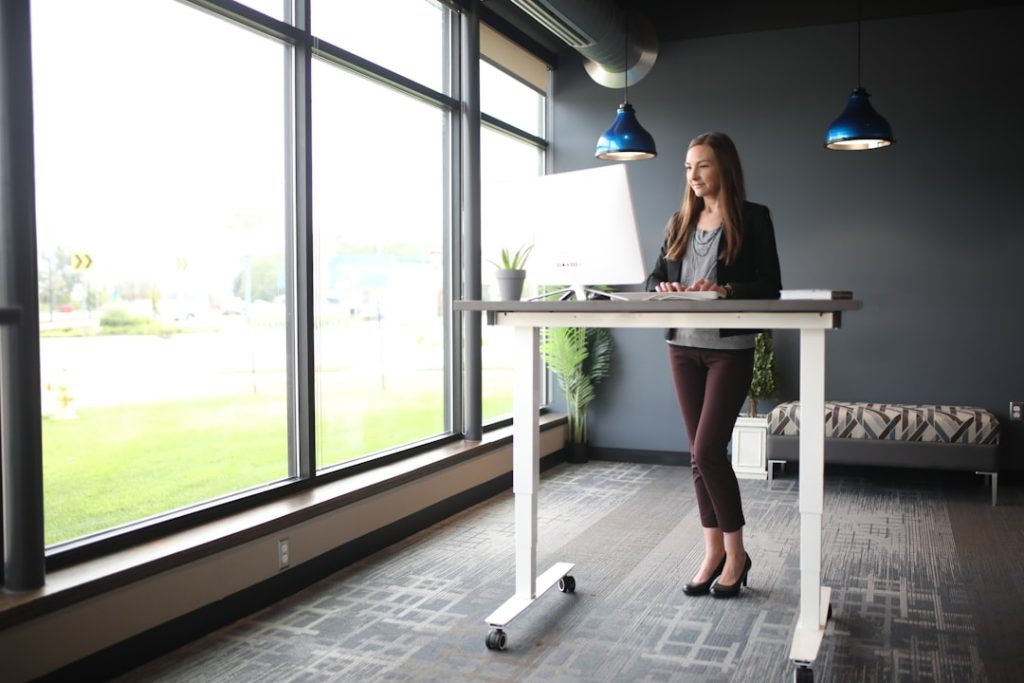
Photo by TheStandingDesk on Unsplash
Photo by Lộc Nguyễn on Unsplash